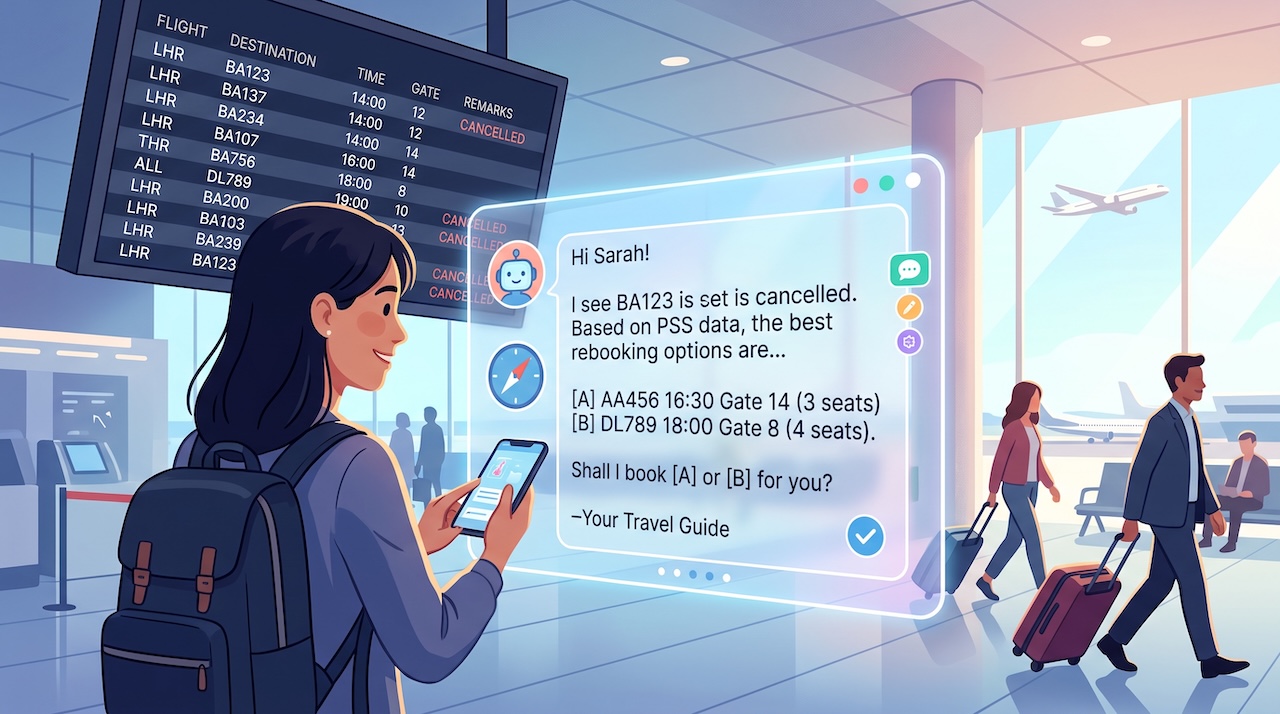
A hotel knows a great deal about a guest that it never tells them. It knows the room is not ready. It knows the restaurant is fully booked at eight but has a table at nine fifteen. It knows the guest has a six a.m. flight and will want a breakfast box rather than a breakfast. Almost none of this reaches the guest unless the guest calls and asks.
Guided stay is the unglamorous idea that the property should say these things first.
The stay has about six moments
Between booking and checkout, most guest contact clusters around a handful of points:
- Pre-arrival, roughly 24 hours out: arrival time, parking, early check-in, anything the guest needs to bring.
- Arrival, on property: room readiness, key collection, luggage.
- First evening: dining, the spa, whatever the property wants to sell that has capacity tonight.
- Mid-stay: housekeeping preferences, engineering issues, extending the stay.
- Departure eve: late checkout, transport, bills.
- Checkout: the folio, the receipt, and anything disputed.
Six moments, each with a small number of predictable needs. The system knows when each one is happening for each guest, which is exactly the information that turns a generic message into a useful one.
Say the thing the guest is about to ask
The test we apply is simple. If a message would still make sense sent to every guest at the same time, it is marketing. If it only makes sense because of what is true for this guest right now, it is service.
“Your room is ready early — 1:40pm instead of 3pm, and your keys are waiting” is service. “Welcome to the property, we hope you enjoy your stay” is not, however warmly it is written.
Properties running guided stay flows see front desk contact fall, but the number they care about is different: the share of guests who take an offer that was made at the moment it was relevant.
Sell only what has capacity
The commercial half of this is where most implementations go wrong. Offering a spa treatment that is fully booked, or a table at a time the restaurant cannot seat, converts a helpful message into an irritation and trains the guest to ignore the channel.
That means the read path has to include real availability — the restaurant’s book, the spa’s diary, the room inventory for an upgrade — and the assistant should stay quiet when there is nothing genuinely available. Silence is a feature.
Where humans belong
Anything about a bill in dispute, anything about a safety or security concern, and anything where the guest is unhappy. All three are moments where the property’s reputation is being decided, and all three are cheap to route to a person who can actually fix it.
The unromantic result
Guided stay does not produce a dramatic contact-volume chart. What it produces is a front desk spending its time on the guests standing in front of it, because the four people who would have called about check-in times already know the answer.