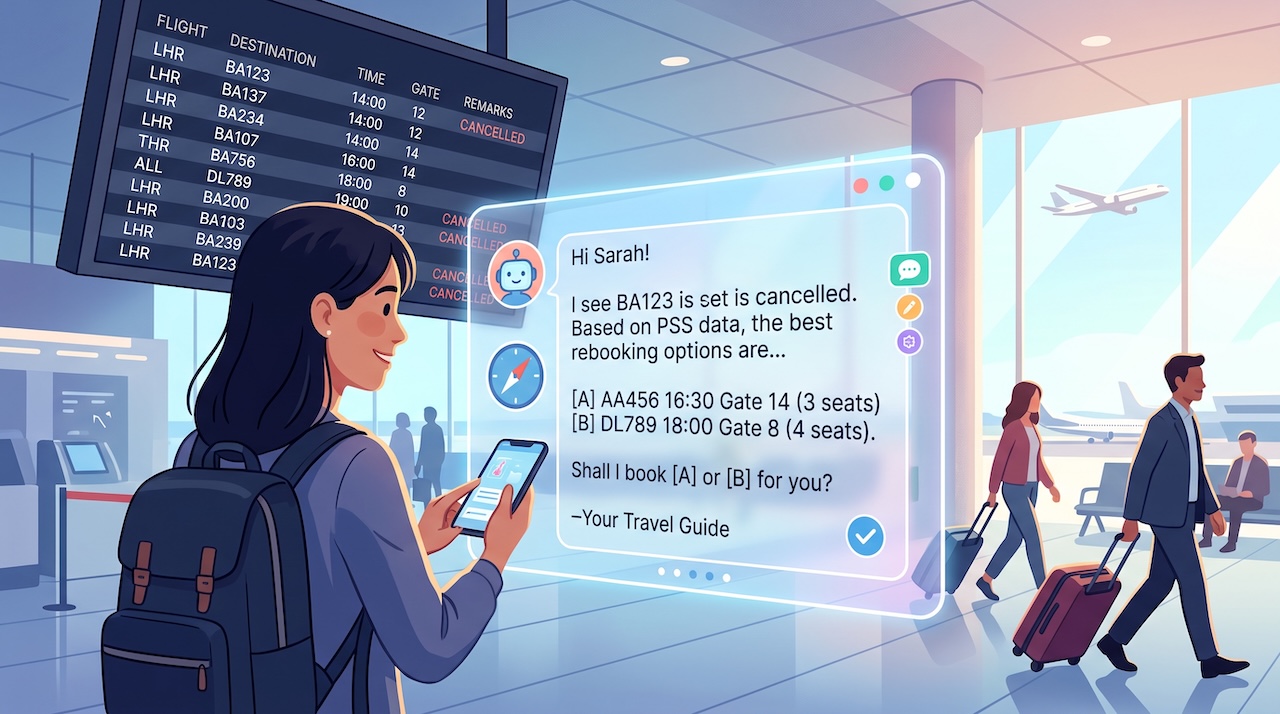
A traveller standing at a bag drop with fourteen minutes before cutoff does not want a chat window. They want one sentence: this bag is fine, go to security at door 3, your gate moved to B14. The information exists. It sits in the passenger service system, the departure control system and the baggage handling feed, and almost none of it reaches the person it concerns until they ask the right question in the right channel.
That gap is what we spend most of our time on with airline customers. It is not a model problem. It is a question of what the assistant is allowed to see, and what it decides to say first.
What the assistant can actually see
Before writing a single flow, we map the read path. For a day-of-travel deployment that usually means the PNR and itinerary, the seat map and boarding status, bag tag events, the current schedule with delay reason codes, and the loyalty tier that governs what can be offered as recovery.
Once those reads are live, the assistant stops answering in generalities. “Checked bags are 23kg” becomes “your bag is tagged and scanned into the hold”. The second answer takes the same effort to generate and removes the reason for the next three messages.
The three questions travellers ask on the day
Across four airline programmes, day-of contact volume collapses into three intents with remarkable consistency. Where am I supposed to be, is my bag with me, and what happens now that something changed.
- Wayfinding and timing. Check-in cutoff, security queue, gate, boarding group. Answerable entirely from systems state.
- Bag status. Tagged, loaded, transferred, or missing. The last case is the only one that needs a human, and it needs one immediately.
- Disruption meaning. Not the delay itself, but the consequence: the connection, the hotel, the rebooking options in tier order.
None of these are hard questions. All three are asked in the worst possible conditions: on a phone, in a queue, under time pressure, often in a second language.
Designing for the moment, not the intent
Intent classification tells you what someone typed. The moment tells you what they need. A traveller ninety minutes from departure who opens the app has a different set of plausible needs than the same traveller two days out, and the assistant should lead with the difference rather than wait to be asked.
The best result we have measured came from an assistant that opened with a statement instead of a greeting. Contact volume for that segment fell by a third.
Practically, that means the first turn is generated from state, not from a template. It also means the assistant needs the discipline to say nothing when there is nothing to report. An opening line that fires on every session becomes noise within a week.
Where the handoff belongs
Two categories should never be contained: a missing bag, and anything involving money the airline owes. Both are moments where the traveller is measuring whether the airline is on their side, and both are cheap to route correctly.
When the handoff happens, the agent receives the transcript, the systems state the assistant read, and the specific action it was unable to complete. Agents on our airline deployments open a conversation already knowing the PNR, the bag tag and the recovery options that were offered. The average handled time drops because the first ninety seconds of re-interviewing disappears.
What we measure
Containment rate alone will push a team towards refusing to escalate. We pair it with three numbers: repeat contact within four hours, the share of sessions where the assistant led with a state-based statement, and agent-reported context quality on transferred conversations.
The last one is a survey question with a single field, answered by the agent after the call. It is the least sophisticated metric in the set and the most reliable early warning that a read path has gone stale.