Airlines are good at recovering from disruption. The aircraft get repositioned, the crews get re-rostered, the schedule gets rebuilt, and the operations centre does it under time pressure with an impressive amount of skill.
What does not scale is telling people. A single storm at a hub produces tens of thousands of individually different consequences, and the traditional channels — a gate announcement, a template SMS, a contact centre with a four-hour queue — deliver roughly the same message to all of them.
The message is not the delay
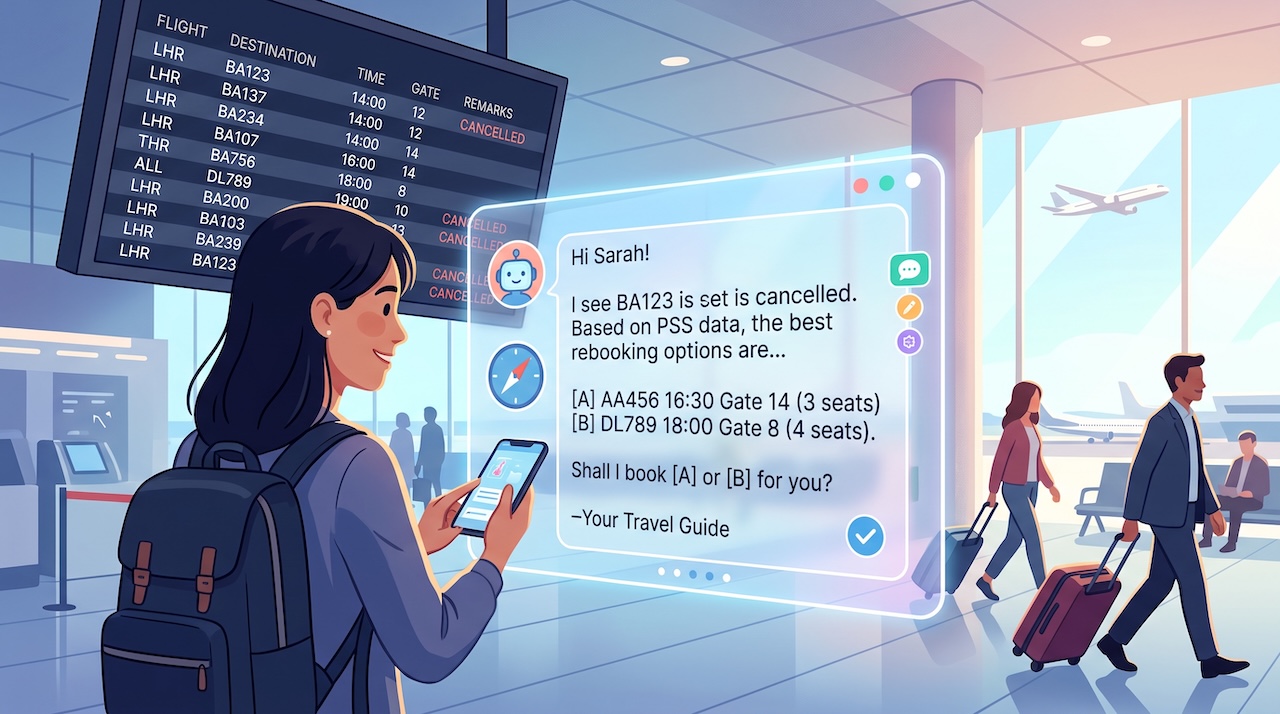
A delay notification tells the traveller something they already know, usually after they have found out from the board. The useful message is the consequence: your connection no longer works and you are protected on the 19:40; your bag will travel on the original flight and be held at the carousel; you are entitled to a hotel and here is how to claim it.
Each of those requires reading the specific traveller’s itinerary against the rebuilt schedule. None of them can be templated, which is exactly why they are usually not sent.
Say it in the order the traveller needs it
Under stress, people can hold about three facts. We order them the same way every time:
- What is now true for you. The new flight, the new time, the new gate.
- What you need to do. Nothing, or something specific and immediate.
- What you are entitled to. Hotel, meals, rebooking options, compensation where it applies.
Anything else — the reason for the delay, the apology, the policy reference — goes after those three or not at all.
The most common complaint in a disruption is not the disruption. It is not knowing. The second is being told something different by three parts of the same airline.
Consistency across channels is the hard part
The app, the SMS, the gate agent and the contact centre must be reading the same state. Where they are not, the traveller’s trust collapses faster than the schedule did, and the contact volume goes up rather than down because people call to find out which version is true.
This is an integration problem rather than a conversational one, and it is worth solving before any of the messaging work.
Push before they ask, then be available
Proactive notification handles the majority. What it cannot do is handle the traveller whose situation is unusual — a special assistance requirement, an unaccompanied minor, a pet in the hold, a missed connection with a same-day surgery on the other end.
Those need a person, and during irregular operations the contact centre is precisely when a person is hardest to reach. Which is the argument for containing the routine cases well: not to save cost, but so the queue is short enough for the traveller who genuinely cannot be helped by a message.
What good looks like
In the deployments we would call successful, the traveller learns what a disruption means for them before they reach the gate, hears the same thing from every channel, and gets a human quickly when their case is not routine. None of that requires a better model. It requires the schedule, the itinerary and the entitlement rules to be readable in the same moment.